
Almost Eden's guide to growing, planting, fertilizing, training and pruning Honeysuckles. As far as growing, planting, pruning and training go, it applies to all kinds of Honeysuckle, not just Coral Honeysuckle.
Flowers, Hummingbirds and Berries
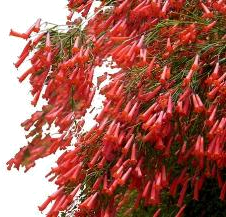
In its most common form, Coral (or Trumpet) Honeysuckle, Lonicera sempervirens, has clusters of narrow, 2-inch tubular flowers, red to coral. Newly opened flowers show bright yellow pollen and a yellow throat that turns red as the flower ages — possibly depending on whether it's been pollinated. Rare forms have been found with solid sunny-yellow, orange, and various shades of red flowers.
- The flowers are a perfect fit for the bill of the Ruby-throated Hummingbird and other hummingbirds that share its range.
- Larger butterflies, some pollinating moths and some larger bees visit too.
- Larger bees are known to rob nectar from flower buds that haven't opened yet. If you see small round holes at the tip or base of a bud, just know your plant is being used to its fullest!
Berries: wherever a flower was pollinated, a green berry forms and ripens into a plump, round, clear orange-red to red fruit about 1/4 inch across or a little bigger. Like the flowers, they often come in generous clusters, and songbirds enjoy them once they're ripe.
Deadheading — removing the berries — encourages more growth and flowers, and helps young plants get established, since they put their energy into growing instead of fruit. We find that when plants are fruiting, almost everything else takes a back seat, and the difference can be significant.
Growth and Pruning
Coral Honeysuckle blooms on new growth. Give it plenty of food, sun and water for healthy growth, and it will get established and start drawing in hummingbirds sooner.
- Like many woody vines, it can take 5 years or more to reach its full potential — but by year 3 it should already be putting on a good show.
- After dealing with its nasty cousin, Japanese Honeysuckle, this tough, free-flowering native vine seems like a teddy bear.
- It can climb 12 feet or a little more with support, but can also be kept on a 3- to 4-foot fence with very little training.
- Prune in late fall in our area. Mature plants try to grow new (if slower-developing) flower clusters, often starting in December.
- A little light pruning, shaping and training now and then keeps it in its spot if you want — but it certainly isn't required.
Give It a Good Support
When adding woody vines, we like sturdy, long-lasting supports. Given enough time, any woody vine can become a heavy mass, though Coral Honeysuckle's twining stems weigh less than most, even full-grown and loaded with fruit. (Does a hummingbird sipping from a blossom make the vine heavier, I wonder?)
A durable support lets your Honeysuckle become a fixture in your garden, blooming more and more each year. We've seen them do well on:
- 6-foot chain-link fences
- 3-foot picket fences
- 8- to 12-foot lattice
- Old cedar stumps with short limbs
Almost any long-lasting, sturdy support it can twine around or through will work — as long as there's room for the vine's stems to thicken.
Sun
Sunlight is what all plants are fighting over, elbowing past their neighbors for a better spot for their solar panels — and Coral Honeysuckle is no different. (Woody vines are just lazy shrubs anyway, sprawling over, around and through other plants to get to the best spot without holding themselves up.)
- Full sun, or sun most of the day — preferably 8 hours or more — is best.
- Powdery mildew: Coral Honeysuckle can get this white-to-gray fungus on its leaves, stems and buds. In full sun with reasonably good air circulation, it's generally not worth spraying for. In shade or poor air circulation it can become a problem, and plants can occasionally succumb — but most of the time they outgrow it.
Water and Mulch
- Once established, it's moderately drought-tolerant, but like most plants from the eastern U.S., it grows and blooms better with about 1 inch of rain a week, or the equivalent.
- During the first year or two, steady moisture is essential — newly planted vines may need more than 1 inch a week.
- A breathable organic mulch holds in moisture and keeps weeds down. It's probably all these Honeysuckles get in nature, and it does so much good — moderating soil temperature, feeding the soil life, sheltering nematode predators — that it shouldn't be overlooked, especially while they get established.
Soil and Native Range
Lonicera sempervirens means "evergreen honeysuckle," but it only stays mostly evergreen in the southernmost part of its range.
- It's native throughout much of the eastern U.S., west to central Texas, and has been introduced into Canada.
- Locally we find it on well-drained, sandy, often acidic soils at the edges of the woods and along fencerows.
- On the USDA PLANTS distribution maps, it seems less common where soils are alkaline. Some sources say it does fine in mildly alkaline soil, though we haven't tried it.
- Best: a well-drained, moderately fertile, loamy, acidic soil for this easy, show-stopping, manageable climber.
A Quick Note on Planting (Then I Promise to Stop Rambling)
Any plant you get from our nursery is already growing at the right depth in its pot.
- After watering it in thoroughly (three times, minimum, according to John) and once everything settles, the top of the root ball should be even with the surrounding soil.
- If drainage is a concern, slope the surrounding soil up to meet the top of the root ball, like a pitcher's mound.
- Tomatoes can be planted deeper, but they're the exception. For acid-loving ornamentals, the only thing that should go on top of an intact root ball is a good organic mulch — like pine straw, our personal weed-fighting weapon of choice.
If the root ball falls apart while transplanting and you end up with a stick and some roots:
- Replant it at the same depth it grew before.
- Spread the roots out and firm soil in around and under them so the top is held securely.
- If there's any doubt the plant will stay firm after a good watering, stake it.
- Water again to settle the soil around any disturbed roots.
See our Planting a New Plant in the Garden guide for step-by-step planting.
Given the right conditions, Coral Honeysuckle will bring anyone passing by many seasons of flowers and feathered visitors. It isn't hard to grow. It does want its sunlight, and it should do well in most average, well-drained garden soils. Give it a support and it will climb it. Show it where you want it to go and it will follow — until it can't anymore, and then it'll just build on itself and bloom until the hummingbirds come to quiet it down.
More Good Reading on Coral (Trumpet) Honeysuckle
- Lonicera sempervirens — NC State Extension Gardener Plant Toolbox
- Lonicera sempervirens — University of Florida Extension
- Lonicera sempervirens — Lady Bird Johnson Wildflower Center Native Plant Database
- Woody Plants (Trees, Shrubs and Vines) of Louisiana — Charles M. Allen PhD, Dawn Allen Newman MS and Harry Winters MD
If you have any questions or anything to add, please contact us.
Thank you, and good growing!
Jeff McMillian and the Crew at Almost Eden