
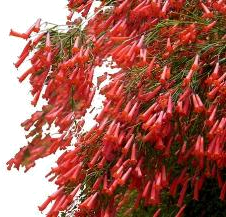
Cacti and succulents make an easy move from their native climates into our homes, offices and greenhouses. As most of you know, they come from places that are:
- Fairly dry: less than 15 inches of rain a year.
- Generally warm: 70°F and up in summer, 50°F and up in winter.
- Sandy and rocky.
They need very little care, and most have few or no pest and disease problems. Most bloom at some point in the year, and some are nicely fragrant, like the Night Blooming Cereus. A few, like Crown of Thorns, bloom almost all year.
Other plants that like the same conditions are often grouped with succulents: Hoyas (Wax Flowers), Buddha's Belly and other plants with swollen bases (caudiciforms), and Mother-in-Law's Tongue (Sansevieria).
Watering
Cacti and succulents need very little water — go on vacation for a week and they generally won't miss you.
- While actively growing (usually spring to fall), they generally don't need water more than about once a week.
- While resting (winter), they need little or no water.
When to water: stick your finger in the soil to the first knuckle. Dry and room temperature? Probably time. Moist and cool? Not yet.
How to water:
- Water from the top and let it drain into the saucer. Watering from the top pulls fresh air into the soil as the water passes through — important for healthy roots.
- After 30 to 40 minutes, dump out any water left in the saucer. If the soil soaked it all up, it may need a second watering.
- Never leave them standing in a saucer of water. That suffocates and eventually kills the roots for lack of air, and invites fungus and disease.
- Over time, you'll learn how much and how often each plant needs.
If the soil ever gets so dry it pulls away from the sides of the pot, water thoroughly several times, or soak the whole pot in a container of water until the soil is fully soaked again. That usually takes 30 to 45 minutes, and up to 1 to 2 hours if the soil is extremely dry.
Pots and Soil
- We grow many of our cacti and succulents in unglazed clay (terra cotta) or other heavy pots, since many get big and top-heavy. Unglazed terra cotta also breathes better, which often means healthier plants for the ones that hate too much moisture.
- Many people add a layer of sand or rock in the bottom of the pot for weight. On top of the soil, it makes a decorative mulch and helps hold a newly transplanted cactus steady while it gets established.
- Use a fast-draining cactus mix when repotting. To make your own, mix 1 part sand or small gravel with 1 to 2 parts of a good potting soil.
- For slow growers, move up just one pot size (for example, from a 6-inch to an 8-inch).
- Low-growing plants usually do better in a shallow pot (less than 4 to 6 inches deep) once you get to 6-inch-wide pots or bigger.
- Trailing and vining types do very well in 6- to 10-inch hanging baskets and can trail 6 feet or more in time — like String of Hearts and Trailing Jade.
Mixed container gardens: because they grow slowly and come in so many colors, textures and shapes, cacti and succulents make long-lasting mixed indoor gardens for medium to bright light.
Light: most prefer the strong light of a south or west window, but a few low-care plants grow well in low light and may even prefer it — especially Mother-in-Law's Tongue (Sansevieria) and String of Hearts.
Fertilizing
Cacti and succulents need very little fertilizer. Too much can make some cacti grow so fast they split their sides, and it can burn roots and stems, stressing the plant and possibly leading to rot.
- Feed only while they're actively growing, or just before their normal growing season.
- We use about 1 teaspoon of a 3- to 4-month, slow-release, non-burning, balanced fertilizer (like Scotts Osmocote 14-14-14) for a 5- to 6-inch pot, spread evenly over the soil, in spring — or during your plant's own growing season, which varies by species.
- Never pile granular fertilizer against the base of the plant. It can burn the stem and roots and lead to stem rot.
A Note
This is a general guide to the basic needs of most cacti, succulents and similar plants. It isn't complete or exact for every one of them. Plants with special needs are worth the time it takes to research them.
See also our Planting a New Plant in the Garden and Container Plant Growing Guide, and our Epiphyllum guide for jungle cacti like Night Blooming Cereus.
More Good Reading on Cacti and Succulents
- Growing Cactus — Texas A&M AgriLife Extension
- Cactus and Other Succulents — University of Illinois Extension
- Cacti and Other Succulents — Cornell Cooperative Extension, Nassau County
- Growing Cactus and Other Succulents — University of Minnesota Extension
We hope this helps get you growing. If you have more questions or need more help, please contact us.
Thank you, and good growing!
Jeff McMillian and the Crew at Almost Eden