

Thai Cajun Red Roselle Hibiscus
Hibiscus sabdariffa var. sabdariffa (ruber)
Now Sabdariffa gossypiifolia (Kew)
- 4.5 in · $14.99
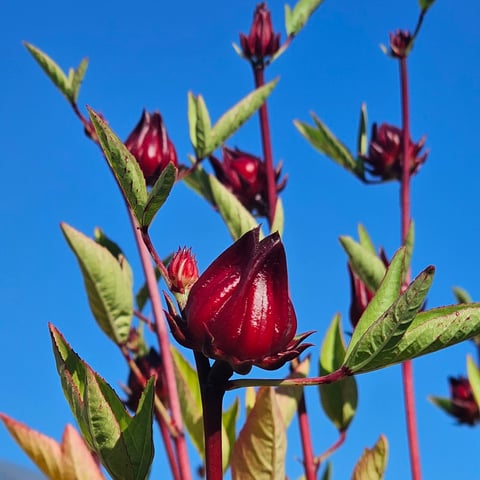
The Roselle that we grow is definitely Hibiscus sabdariffa var. sabdariffa of the race ruber that is known for its large, thick, deep clear wine red, crispy, sweet, cranberry flavored calyxes. A vigorous annual to tender perennial, Roselle Hibiscus prefers a warm, mostly sunny position in a well-draining, humus rich, moderately fertile, sandy-loam and free from competition. All parts of the plant are edible including the roots. It will grow foliage and stems all spring and summer with flowering beginning in the shorter days beginning in late summer and fall. The pink tinged, cream colored, typical 5 petaled, 3" wide, citrus flavored Hibiscus flowers attract a variety of native pollinators and are held against the dark burgundy, glossy stems and deep green, burgundy tinged and veined, and typically 3, 5, or 7 lobed foliage. Under good conditions one to several flowers will be born at each leaf axil over a period which typically lasts for several weeks but is dependent on the arrival of the first killing frosts and freezes in your area. Roselle is considered a perennial in frost free climates. Caterpillar host: Gray hairstreak
The pollinated flowers will develop the swollen, deep red, sweet and tangy epicalyxes that the Roselle Hibiscus is known for. You can snap off the finger-like, fleshy red epicalyxes that surround the harder, inner calyxes that form the okra-like seed pod and eat them fresh, use them in salads, to make sauces, drinks, jams, jellies, pies, or dry them to make the Roselle tea that these plants are famous for. The calyx itself is also edible and can be used just like the epicalyx dried or fresh. You can even use the left over seeds to extract a healthful and flavorful Roselle oil. Young stem tips and leaves can be eaten fresh and in salads, the resulting periodic trimming during the spring and early summer also promote increased branching and thus increased calyx production in the fall. Much of the plant, preferably before it gets woody, including the roots can be cooked as a vegetable. All parts except for the roots and seeds are said to have a tangy flavor but the roots are valued as a starch and a thickener and the healing and curative properties of all its parts are hailed by many peoples across the world. Roselle is certainly high in antioxidants, vitamins, and has even been shown to help with high blood pressure and a variety of other ailments.
Roselle is also known as Florida Cranberry, Red Sorrel, Indian Sorrel, Sour-Leaf, Jamaican Sorrel, and Flor de Jamaica. It can grow up to 8' high where it has good growing conditions and 1 plant can produce up to 16 lbs of whole fresh fruit or up to 2 lbs of dried calyxes. Harvest the fruit when the calyxes when they near full size and before they start to become woody, the epicalyxes will be about 1 to 1-1/4" in length, but generally while you can still snap the entire pedicel, or old flower stem, from the plant easily. If they get too old you may need to use snips. You'll want to harvest all remaining calyxes prior to the first first killing frost or freeze. Occasionally, gardeners may be able to successfully extend their harvest, if the first frosts/freezes are mild and brief, by using light, protective covers for the first few cold nights where feasible.
- Zones
- 10, 11
- Sun
- Full sun, Mostly sun
- Size
- 4-8'H space at 3-5' apart
- Bloom
- Summer and fall.
- Soil
- Average moisture, moist, to wet and are even reported to tolerate soils with standing water. Well drained sandy loams, rich in organic matter seem to be optimum.
Family: Malvaceae
Find it in: Hibiscus, Butterfly Plants, Fruits & Herbs, Plants by Flower Color, Plants by Foliage Color, Tropical Plants