
Southern Catalpa
Catalpa bignonioides
- 4.5 in · $14.99
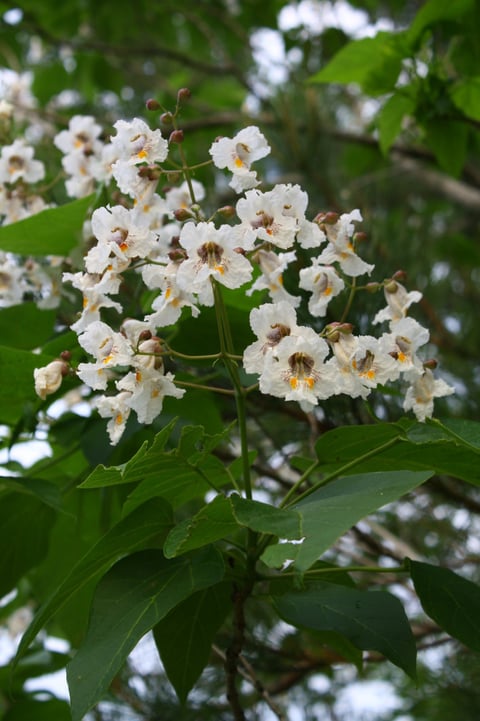
The large pyramidal flower clusters are composed of showy, 1-2" wide, trumpet shaped, fragrant, white flowers that are accented by larger yellow-orange dots and numerous smaller purple dots and lines in the throat that act as bee guides. Flowering occurs over a few weeks in mid to late spring and the nectar and pollen rich flowers attract a number of different pollinators but is considered especially important to larger native bees and honeybees. The Southern Catalpa, Catalpa bignonioides, is a naturally pyramidal shaped, fast growing tree when young quickly reaching flowering size at about 15-25' high under good conditions and with ample moisture and moderate fertility. With age, this deciduous tree develops an upright to rounded crown and can reach heights of 40-60'. The large medium green leaves often produce good yellow fall color. Provide a full to mostly sunny site in an average moist soil for optimum vigor and flowering.
The Southern Catalpa is suitable for use as a street or lawn tree although it does drop its large beans between late fall and early spring. The large, tropical looking, heart shaped leaves turn yellow just before falling off in autumn. After reaching the 25-40' height range, depending on growing conditions, growth tends to slow down but you can still expect them to average about 1' or a little more per year each year after that. They can reach 60' x 60' under good conditions.
Often 'planted' accidentally, you can still find neat rows of large Catalpa trees in northern Louisiana many of which may have originated as fence posts. My grandfather taught us that you needed to plant these naturally rot resistant posts upside down because if you used them fresh they could grow into trees that are hard on wire fencing. He said on occasion they would manage to do so anyway, and so we have one still in the fence line to this day that is proof of it. The Southern Catalpa is also planted to attract the Catalpa Worm, (sometimes misspelled as Catawba, Catawbler, Catawber, etc...) the large green and black hornworm caterpillar of the Catalpa Sphinx Moth and are a widely sought after fish bait. The light gray wood has good rot resistance.
The Southern Catalpa has the potential to become weedy in some regions of the country. If it is not a known native to your area consider checking with your local county extension agent before planting this tree.
- Zones
- 5, 6, 7, 8, 9
- Sun
- Full sun, Mostly sunny, Part shade
- Size
- 20-40'H x 20-30'W to 60'H x 60'W
- Bloom
- Mid to late spring.
- Soil
- Tolerant of most soil types but enjoys average to regular moisture and moderate fertility. Moderately drought resistant once well-established.
Family: Bignoniaceae
Find it in: Shrubs & Trees, Bee Plants, Butterfly Plants, Fragrant Plants, Heirloom Plants, Louisiana Native Plants, Native Plants, Plants by Flower Color, RHS Award of Garden Merit® Plants, Songbird Plants