

Lady Margaret Passion Flower
Passiflora 'Lady Margaret'
- 4.5 in · $17.99
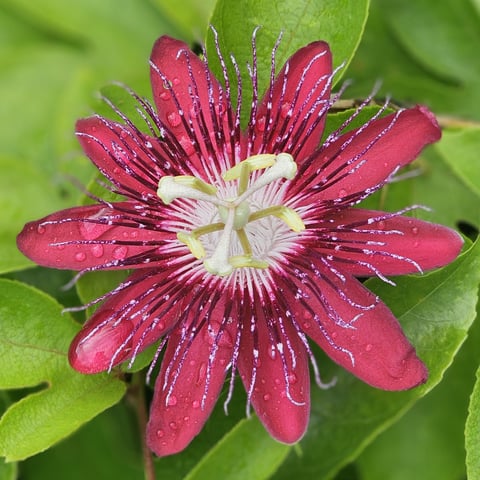
The large, 3-4" wide, raspberry red flowers are centered by a corolla of raspberry red filaments that fade to bright white at the center. Lady Margaret Passionflower is a prolific flowering hybrid that is a showoff throughout the year in frost free conditions. The fuzzy foliage and stems are utilized by Gulf Fritillary, Julia Butterfly, Variegated Fritillary, and Zebra Longwing butterfly caterpillars. A tamer passionvine than many others but it certainly does not lack for vigor.
Lady Margaret has rarely fruited under our growing conditions although it may occasionally produce a fruit here or there. Most sources suggest that fruit are poor and may even be nearly empty if produced at all. It is considered to be a cross with either P. incarnata x P. coccinea. Some sources have suggested P. caerulea x P. vitifolia.
As tropical as it looks to be the Lady Margaret Passionflower is reported to survive in zone 8B if provided with a protective mulch and is established as early in the growing season as possible. We have not yet tested this and so this report is only anecdotal. If it does survive the freezes, it is slow to resprout until soil temperatures have sufficiently warmed in spring.Passionvines are tropical plants that we are often able to grow and enjoy as die-back perennials in areas where winter brings freezing temperatures and some can even remain evergreen in mild winters in zone 8B. *Note: To help give them the best chance of returning in the ground they should be planted as early in the growing season as possible in order for them to be able to establish a strong root system and well-established crown from which they can return the following spring. A breathable insulative protective mulch, like pine straw, will also help to improve their chances of returning. Containerized Passionvines are susceptible to the soil freezing and could be killed by it anywhere temperatures remain below 32°F for any real length of time and so may need to be brought indoors or grown in a greenhouse during cold spells. Some of the hardiest and most reliable species to look for are Blue Crown Passionvine, Passiflora caerulea, and its cultivars like Bahama Blue, Clear Sky, and Constance Elliot (these may remain evergreen even with dips into the 20°F's for short periods); Maypop Passionvine, Passiflora incarnata; and the Yellow Passionvine, Passiflora lutea. Even though these last two are considered root hardy into zones 5 and 6 they still need to be established as early in the growing season as possible. They both typically will go completely dormant in fall and winter. Other cultivars that have impressed us with their ability to return here in zone 8 are Lady Margaret (may return from the roots even in 8A ) and Aphrodite's Purple Nightie (like Blue Crown, we have seen it remain evergreen into the 20°F's for short periods).
Note: Lady Margaret is not typically grown for fruit production. In order to produce their delicious tangy tropical tasting fruit Passionflowers must be cross-pollinated by another seedling, species, or cultivar. Bumblebees are perfectly designed for this as the pollen is rubbed on their back as they circle the corona drinking nectar and then carry it to the next flower. With most passionflowers the 5 stamens (pollen producing glands) arch downward once they are ready to release their pollen (and nectar) then on the next flower, hopefully, the 3 stigmas will arch downward once they are ready to receive pollen thus doing the work to produce fruit if the pollen is accepted. We generally wait until the fruits become yellow (in yellow fruited cultivars) and wrinkled and have fallen from the vine. To learn more see the Passionfruit datasheet by Purdue Horticulture:https://hort.purdue.edu/newcrop/morton/passionfruit.html#Varieties
- Zones
- *9, 10, 11, (*8B?)
- Sun
- Full sun, Mostly sunny, Part shade, Part sun
- Size
- 6-12'H+, reported to reach 30'+ where winters are mild.
- Bloom
- Spring, summer, fall and potentially winter under warm tropical conditions.
- Soil
- Average moist, fertile, average to well-drained soils.
Family: Passifloraceae
Find it in: Passionvines, Bee Plants, Butterfly Plants, Fragrant Plants, Perennials, Plants by Flower Color, Vines and Vine-like Plants