

Fruit Cocktail Shrimp Plant
Justicia brandegeeana 'Fruit Cocktail'
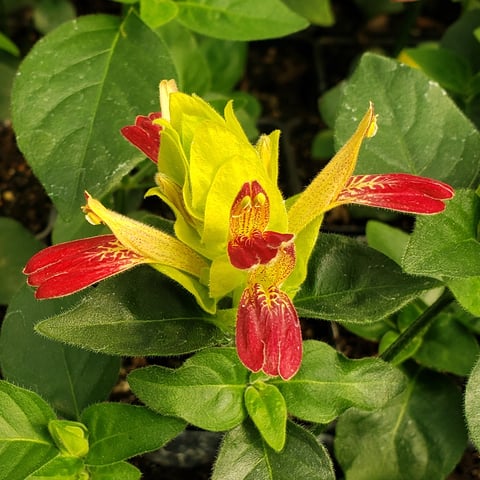
- 3.5 in · $12.99 · 17 available
The red to pinkish-red and white tubular flowers emerge from between the spikes of chartreuse bracts from spring to fall to year-round under warm tropical conditions. The Fruit Cocktail Shrimp Plant, one the newest selections of Justicia brandegeeana, has a naturally more compact, better branching habit than the typical Red Shrimp Plant but in all other regards it is nearly identical. It is quite tolerant of light conditions ranging from full sun to light shade but may have the densest habit in sunnier conditions. The flowers attract hummingbirds, larger butterflies, and other pollinators. Caterpillar host: Cuban Crescent, Texan Crescent, White Peacock, and Malachite. Use Shrimp Plants to add color in containers, as a specimen plant or in mixed container gardens, as well as in the garden and landscape. Provide an average to well-drained, moderately fertile, average moist soil for optimum vigor and flowering.
In zones 9 and 10 the Shrimp Plant, Justicia brandegeeana, makes a fairly reliable perennial in well-drained soils readily returning from the roots in spring if freezes or hard frosts occur. Where it doesn't freeze back, it can begin flowering in late winter or early spring lasting until fall and it can also be utilized as an outstanding medium-sized 12-18" groundcover that your hummingbirds will love you for. In zone 8B as a die-back perennial (a tropical that returns from the plant's crown in spring) it often returns from the roots in mid to late spring if mulched but it may be mid summer before it begins to flower again depending on the growing conditions. Outside of zones 9 and 10, it may be best to enjoy the Shrimp Plant as an annual and if it does return in time then so much the better.
Why is a Shrimp Plant called a Shrimp Plant? The tubular red, yellow, orange, or white flowers that emerge from in between the colorful bracts of the flower spike have dark maroon markings in their throat and these act as a bee-guide directing pollinators to the nectar reward. These bee-guide markings are reminiscent of the gills and innards of the shrimp. Two dark colored pollen containing anthers that protrude from just below the uppermost petal create the 'stalked eyes' of a shrimp. The three lobes of the lower lip of the flower look like the fanned tail of the shrimp as if the 'shrimp' is curled around with only the head and tail exposed.
- Zones
- 9, 10, 11, (8B?, 8A?)
- Sun
- Full sun, Part shade, Part sun, Filtered shade, Light shade
- Size
- 12-18''H x 12-18''W
- Bloom
- Spring to frost to year-round under warm tropical frost free conditions.
- Soil
- Average moist to moist (never soggy wet), moderately fertile, well-drained soils.
Family: Acanthaceae
Find it in: Groundcovers, Butterfly Plants, Hummingbird Plants, Perennials, Perennials by Size Class, Plants by Flower Color, Plants by Foliage Color, Shade Tolerant Plants, Tropical Plants