
Copper Iris
Iris fulva
- 3.5 in · $19.99
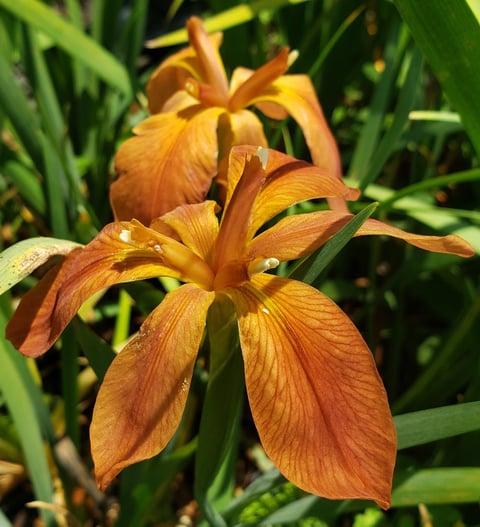
Coppery colored falls and standards are overlaid with darker colored veining and lighten toward their bases and are produced in early to midseason on sturdy 18-24" high stalks. The red toned flowers are hummingbird pollinated where most other species of the Louisiana Iris group are pollinated by larger bees. The Copper Iris, Iris fulva, is smaller in all regards to most Louisiana Iris species and cultivars in that it produces 3-4" wide flowers with drooping petals, the rhizomes are consistently in the 3/4" diameter range, the foliage is typically less than 1" wide, and the plants top out at around 18-24" high. The Copper Iris is most commonly found in the southern half of the Mississippi River basin and along the Louisiana portion of the Red River in consistently wet to moist areas but not submerged. It has been used widely to develop red flowering crosses and is a parent of Nelson's Louisiana Iris, a.k.a. the Abbeyville Red Iris. Like the Louisiana Irises, the Copper Iris is an easy and adaptable, rhizomatous perennial with fans of medium green, narrow sword-like foliage and seems as at home near standing water as they do in average moist garden soils. Remember that these plants do most of their growing in fall and winter and so this is when they should be fed and fall is also a great time to divide plants if desired. Provide a full sun to partly shaded site for optimum vigor and flowering.
These plants were originally shared with us as Iris nelsonii, but in our humble opinion we feel that they are much closer to the species I. fulva. If you feel we have made an error in this assessment please feel free to contact us. We have a few different clones that have been shared with us over the years and the image shown is of the plants we separate as Green II, and if you purchase one you may see "I NELSONII GREEN II" on the containers from this seasons offerings in 2024.
These easy to grow perennials are happy to grow under average garden conditions provided you understand their growth habits. Louisiana Irises are mid to late summer dormant and fall, winter, and spring growing. They are accustomed to a short dry period during the dog days of August and September here in Louisiana in the low areas. October averages to be our wettest month, with consistent rains throughout fall, winter, and spring when flowering generally occurs. Consider fertilizing them if needed during these growing periods if soils are poor. The parents of many of these species grow in the bayous where the sediment and nutrients from the meltwater of northern spring rains is deposited in these drainages as much of the central and northern US drains into Louisiana via the Red, Mississippi, and the many other water ways that drain into them. And so in the spring time they naturally expect an influx of new nutrients to help them produce their beautiful flowers. This is followed by fruit production and something of a pause in top growth with rhizome development. As the fruits become fully ripened spring foliage begins to yellow and fade away as the roots absorb all the nutrients stored in them to develop the buds of next spring. At this point the ugly foliage can be pruned away but may be best left to protect and shade the young foliage during the hottest parts of summer.
- Zones
- 6, 7, 8, 9
- Sun
- Full sun, Mostly sunny, Part shade, Part sun
- Size
- 16-24"H, space at about 8-12" apart
- Bloom
- Early to midseason or March to April
- Soil
- Wet, moist, to average moist, moderately fertile soils rich in organic matter. An organic mulch is recommended under average moist conditions in typical garden settings.
Family: Iridaceae
Find it in: Groundcovers, Cut Flowers, Deer Resistant Plants, Heirloom Plants, Hummingbird Plants, Iris, Louisiana Native Plants, Native Plants, Perennials, Perennials by Size Class, Plants by Flower Color, Plants for Bogs & Wet Areas, Rare & Unusual Plants