

Blue Porterweed - Native
Stachytarpheta jamaicensis
- 3.5 in · $12.99 · 30 available
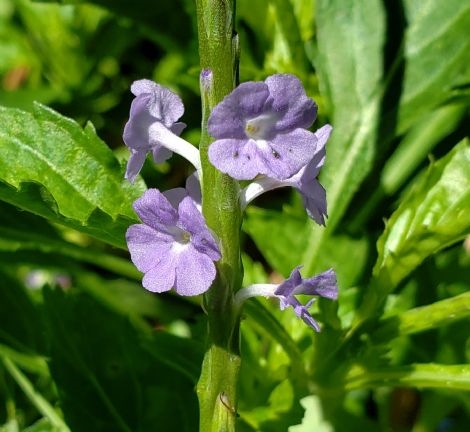
Light blue to blue-purple 1/4" wide nectar-rich flowers adorn the tall narrow indeterminate flower spikes from spring to frost to year round under warm tropical conditions. Native to Florida and much of the tropical Americas, Blue Porterweed, Stachytarpheta jamaicensis, has smoother lighter green foliage and generally grows wider than tall whereas the other Blue Porterweed, Stachytarpheta cayennensis or S. urticifolia, has more rugose or quilted deeper green glossier foliage with a typically upright habit. Porterweeds are excellent pollinator plants where they attract a continuous menagerie of aerial acrobats from spring until frost. This a heat and sunloving tropical to tender perennial that can be added to gardens and landscapes or plant them in containers to draw the pollinators in for up close viewing. Blue Porterweed is also a caterpillar host plant for the Tropical Buckeye butterfly.
Light to medium blue 1/4" wide nectar-rich flowers adorn the tall narrow indeterminate flower spikes from spring to frost to year round under warm tropical conditions. Native to Florida and much of the tropical Americas, Blue Porterweed, Stachytarpheta jamaicensis, has smoother lighter green foliage and generally grows wider than tall whereas the other Blue Porterweed, Stachytarpheta cayennensis or S. urticifolia, has more rugose or quilted deeper green glossier foliage with a typically upright habit. Porterweeds are excellent pollinator plants where they attract a continuous menagerie of aerial acrobats from spring until frost. This a heat and sunloving tropical to tender perennial that can be added to gardens and landscapes, used as a groundcover, or plant it in containers to draw the pollinators in for up close viewing. Blue Porterweed is also a caterpillar host plant for the Tropical Buckeye butterfly.
Porterweeds are likely the number one favorite nectar plant for butterfly gardeners and surely for the butterflies themselves. I would be surprised to find a plant that produces a more continuous supply of nectar rich flowers from summer to frost, even most Lantana has to catch its breath from time to time during the heat of summer. This is one of the few plants that you will find consistently at nearly every butterfly conservatory. Outside of frost and freeze free climates like zones 10-11, Porterweeds may be best treated as spring to frost annuals but can be overwintered in a warm greenhouse or sunroom. Porterweed may reseed, particularly in mild winter climates.
To learn more about the detailed differences between the Florida native and the non-native Blue Porterweeds see the publication "Stachytarpheta jamaicensis" by Stephen H. Brown, Horticulture Agent, and Kim Cooprider, Master Gardener, from the Lee County University of Florida Extension. Please plant this species responsibly as it is considered to have the potential to escape although it is not listed as a Noxious Weed at the time of this writing.
Interestingly the flowers of S. jamaicensis and S. frantzii, along with other species, are repellent to some species of ants which prevents nectar robbing. For more information see the research paper "Nectar Theft and Floral Ant-Repellence: A Link between Nectar Volume and Ant-Repellent Traits?" by Gavin Ballantyne and Pat Willmer. The textual version of the link is here:
https://www.ncbi.nlm.nih.gov/pmc/articles/PMC3430612/
Porterweeds can also be used as fresh cut flowers that can last a week or more. Harvest the stems after at least the first set of flowers have begun opening at the base of the flower spike. Cut the flowering stem to the desired length somewhere below the first set of leaves, which can be left on the stems and may potentially help the flowering last longer, and place the freshly cut stems in clean fresh water.
- Zones
- 10, 11, (9B?)
- Sun
- Full sun, Mostly sunny, Part shade, Part sun
- Size
- 12-18"H x 18-30"W
- Bloom
- Spring-frost or year round in warm, frost free conditions.
- Soil
- Average moist, average to well-drained soils. Tolerant of sandy soils.
Family: Verbenaceae
Find it in: Groundcovers, Bee Plants, Butterfly Plants, Cut Flowers, Deer Resistant Plants, Hummingbird Plants, Louisiana Super Plants, Native Plants, Perennials by Size Class, Plants by Flower Color, Porterweeds, Salt Tolerant Plants, Tropical Plants, Rare & Unusual Plants