
Blue Porterweed
Stachytarpheta cayennensis
- 3.5 in · $12.99 · 9 available
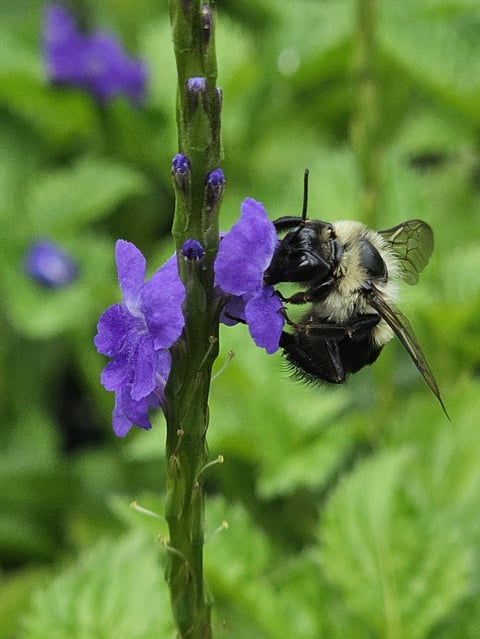
Blue, indigo, to purple 1/4" wide flowers adorn the long spike-like flowering stems from spring to frost and are held above the rich green glossy foliage. Blue Porterweed, Stachytarpheta cayennensis, is an intermediate growing Porterweed and has a fairly dense upright to spreading habit. An excellent choice for butterfly gardens or as a container plant. For the Florida native Blue Porterweed see Stachytarpheta jamaicensis. Provide a full to mostly sunny site in an average moist, fertile soil.
Porterweeds are likely the number one favorite nectar plant for butterfly gardeners and surely for the butterflies themselves. I would be surprised to find a plant that produces a more continuous supply of nectar rich flowers from summer to frost, even most Lantana has to catch its breath from time to time during the heat of summer. This is one of the few plants that you will find consistently at nearly every butterfly conservatory. Outside of frost and freeze free climates like zones 10-11, Porterweeds may be best treated as spring to frost annuals but can be overwintered in a warm greenhouse or sunroom. Porterweed may reseed, particularly in mild winter climates.
We had previously and mistakenly offered this as Stachytarpheta jamaicensis, it is in fact Stachytarpheta cayennensis (original item# was 330). To learn more about the detailed differences between the two please see the publication "Stachytarpheta jamaicensis" by Stephen H. Brown, Horticulture Agent, and Kim Cooprider, Master Gardener, from the Lee County University of Florida Extension. Please plant this species responsibly as it is considered to have the potential to escape although it is not listed as a Noxious Weed at the time of this writing.
Interestingly the flowers of S. jamaicensis and S. frantzii, along with other species, are repellent to some species of ants which prevents nectar robbing. For more information see the research paper "Nectar Theft and Floral Ant-Repellence: A Link between Nectar Volume and Ant-Repellent Traits?" by Gavin Ballantyne and Pat Willmer. The textual version of the link is here:
https://www.ncbi.nlm.nih.gov/pmc/articles/PMC3430612/
Porterweeds can also be used as fresh cut flowers that can last a week or more. Harvest the stems after at least the first set of flowers have begun opening at the base of the flower spike. Cut the flowering stem to the desired length somewhere below the first set of leaves, which can be left on the stems and may potentially help the flowering last longer, and place the freshly cut stems in clean fresh water.
- Zones
- 9B, 10, 11
- Sun
- Full sun, Mostly sunny, Part shade, Part sun
- Size
- 3-4'H x 2-3'W
- Bloom
- Spring-frost or year round in warm, frost free conditions.
- Soil
- Average moist, fertile soils with average or better drainage.
Family: Verbenaceae
Find it in: Tropical Plants, Bee Plants, Butterfly Plants, Cut Flowers, Louisiana Super Plants, Perennials by Size Class, Plants by Flower Color, Porterweeds