

Ayesha Big Leaf Hydrangea
Hydrangea macrophylla 'Ayesha'
- 4.5 in · $17.99
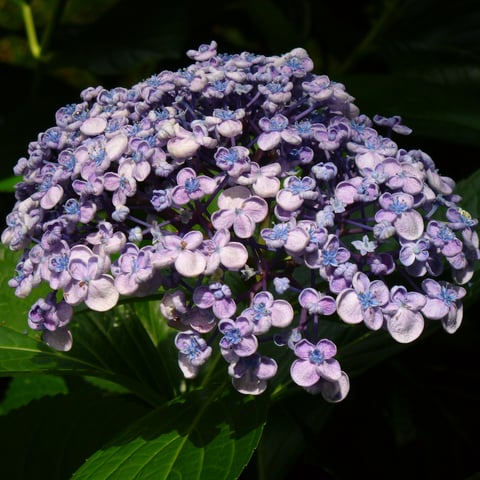
One of the most amazing Hydrangea's as each flower petal is slightly cupped producing a much different effect as the large, long lasting flower clusters of deep blue or pink emerge in late spring. A must for any Hydrangea lover and a beautiful cut flower! Ayesha is truly one of our favorites! According to Dr. Michael Dirr it may also be sold under the names Silver Slipper and Uzu Ajisai.
With the Big Leaf or French Hydrangea, Hydrangea macrophylla, the flower color (the sepals, as a unit they are florets, are actually the part we most enjoy but they do look so much like petals themselves) will vary depending on soil pH. Alkaline ph soils produce pink flowers, neutral pH soils produce purple, and acid pH soils produce the true blues. Actually it is the availability of Aluminum in the soil which is required for Hydrangea macrophylla to produce the color pigment delphinidin. In acid soils you can imagine the Aluminum ions being literally dissolved into the acidic water and being absorbed by the roots of the plant. You can even lime one side of the plant and put Aluminum Sulphate on the other half and produce all three flower colors on the same plant if you get it right. In soilless mixes, like the peat moss or bark based potting soils that they are typically found growing in at the nursery, there is no Aluminum for the Hydrangea to take up, unless it has been added by the grower, therefore the flowers will end up being pink. With white flowered forms of the Big Leaf Hydrangea the florets generally remain white although they may blush pink or blue and the fertile flowers may be blue or pink depending on the soil pH.
Most pruning is generally done after flowering and should be completed before the end of summer. Timing may not be as critical with the repeat flowering Big Leaf Hydrangeas but is still the recommended practice for the best spring flower show the following year as well as overall plant vigor. Prune to shape as desired or to reinvigorate by removing no more than 1/3 of the oldest canes near ground level. We generally only do touch up pruning just before growth begins in spring just to remove the spent flower heads and remove any dead, weak, or freeze damaged wood. With periodic renewal pruning only if vigor seems reduced which is a rarity.
For more information on growing and selecting Hydrangeas below are some excellent online resources:
'Hydrangea Questions and Answers' from The US National Arboretum
'Growing Bigleaf Hydrangea' from the UGA Extension by Gary L. Wade
'Check Out This Alternative Hydrangea' (Oakleaf Hydrangea) from LSU Agcenter by Richard Bogren
'Hydrangeas Provide Color in the Shade' from LSU Agcenter by Dan Gill
'Hydrangea Selection, Pruning, and Care' from Virginia Cooperative Extension by Mike Andruczyk
'Hydrangeas' from Alabama Cooperative Extension Service by Kerry Smith, Jerry Chenault, and Kenneth Tilt
Dr. Michael Dirr's book Hydrangeas for American Gardens, ISBN 0- 88192-641-8, is probably the most in depth publication covering practically all Hydrangea species and all but the newest cultivars.
- Zones
- 6, 7, 8, 9
- Sun
- Part shade, Morning sun, Filtered sun, Full sun in cool summer climates
- Size
- 4-5'H x 5-6'W
- Bloom
- Mid to late spring to early summer. Earlier in warmer winter climates.
- Soil
- Moist to average moist, but not wet, moderately fertile, humus rich, well-drained soils. An organic mulch is highly recommended, especially in zone 8 and colder.
Family: Hydrangeaceae
Find it in: Hydrangeas, Great Plant Picks for the Pacific Northwest, Plants by Flower Color, Shrubs & Trees, Shrubs by Size Class, Drought Resistant Plants